When making American recipes, first checking whether you are measuring by volume or by weight makes things much less confusing. Cup, tablespoon, teaspoon and fluid ounce are units of volume; ounce and gram are units of weight. Even though they look similar, do not read fl oz and oz as meaning the same thing.
This guide covers U.S. units, and we checked official information from NIST (the National Institute of Standards and Technology) and manufacturers on October 16, 2026. We show numbers rounded for cooking separately from more precise conversion values. If a recipe specifies mL or g, give priority to those numbers.
Cheat sheet for cup, tbsp, tsp and fl oz
| Notation | Name / meaning | Approximate value for home cooking |
|---|---|---|
| 1 tsp | teaspoon | About 5 mL |
| 1 tbsp | tablespoon | About 15 mL |
| 1 fl oz | fluid ounce | About 30 mL |
| 1/4 cup | One-quarter cup | About 60 mL |
| 1/3 cup | One-third cup | About 80 mL |
| 1/2 cup | Half cup | About 120 mL |
| 1 cup | One cup | About 240 mL |
The table is based on NIST’s approximate conversions for home cooking. Converted more precisely, 1 U.S. fl oz is about 29.5735 mL, and 1 cup (8 fl oz) is about 236.588 mL. Likewise, 1 tsp is about 4.93 mL and 1 tbsp is about 14.79 mL. “1 cup is about 240 mL” and “about 236.6 mL” are simply explanations that round differently.
Partway through a single recipe, repeatedly converting the cups to precise values and the spoons to a different approximation can lead to copying errors. If the original recipe assumes U.S. measuring cups, use those tools; if you want to work entirely in mL, rewrite the ingredient list first to make it easier to handle. Measuring consistently in the way the recipe specifies matters more than writing out detailed numbers.
fl oz and oz: separate liquid volume from ingredient weight
1 oz weighs about 28.35 g. On the other hand, 1 US fl oz indicates a volume of about 29.57 mL. You cannot measure “8 fl oz of liquid” and “8 oz of flour” using the same line on a measuring cup. Even for liquids, use a scale if the recipe specifies oz by weight. Don’t assume “it’s a liquid, so it must be fl oz”; read all the way to the unit.
The container capacity you see when shopping and the weight in an ingredient list are also different pieces of information. For example, a container labeled 16 fl oz will not necessarily hold 16 oz of any ingredient. When choosing storage containers, check the volume of what you want to put in them; when measuring ingredients, check the recipe’s units. Don’t rely on the number alone.
Don’t use your rice cooker’s rice cup as a cooking cup
Zojirushi’s official specifications for its U.S. NHS series express cooking capacity based on uncooked short-grain white rice and a rice measuring cup of about 180 mL. This rice cup differs from the U.S. cooking cup, which is treated as about 240 mL. Even if a rice cooker says something like “3 cups,” that is not necessarily the same volume as the 3 cups used in a typical recipe.
For example, using the approximate cooking conversion, 2 cups of liquid is about 480 mL, but 2 rice cups of 180 mL each is 360 mL. In this example, that is a 120 mL difference. Conversely, if you measure rice with a cooking cup and then use the cup-number markings in the inner pot, you will be off from the intended ratio. For cooking rice, give priority to the cup that came with your model and the instructions in its manual.
When storing them, keeping the rice cup with your rice cooker accessories and separate from your cooking measuring cups makes them harder to mix up. If you lose the included cup, look up the replacement part and its capacity by model name before substituting a similar-looking container.
Don’t apply a single “1 cup = X g” rule to flour and other dry ingredients
Even at the same volume, weight changes depending on the ingredient and how it is packed. King Arthur Baking states that 1 cup of its Unbleached All-Purpose Flour = 120 g. This is not a number that applies to all flours or to sugar. If a recipe lists grams for each ingredient, using those is the clearest method.
The company’s measuring guide describes spooning dry ingredients lightly into a dry measuring cup and leveling off the top, and reading liquids at eye level against the markings on a liquid measuring cup. Packing flour by pushing the cup into the bag and spooning it in lightly produce different conditions. If the recipe you want to reproduce explains how to measure, follow that procedure as well as the units.
Do the math for halving a recipe before you start cooking
As an example, consider halving “1/3 cup liquid, 1 tbsp seasoning.” Using the approximate home-cooking values, the liquid is 80 ÷ 2 = about 40 mL and the seasoning is 15 ÷ 2 = about 7.5 mL. This is a calculation example, not the proportions for any particular dish. Rather than halving amounts in your head after you start mixing, writing the ingredient names and new amounts side by side lets you check that nothing was left out.
When you change quantities, don’t simply halve the temperature or cooking time as well. Also, 1/2 tsp and 1/2 tbsp are different amounts, so don’t copy the numbers alone. With a newly bought set of measuring spoons, checking the markings on the handles and setting out the sizes you need before measuring reduces mistakes.
The order for reading a recipe
- Check whether it is an American recipe or uses another country’s system of units.
- If mL and g are also listed, decide which notation you will use.
- Distinguish fl oz from oz, and tsp from tbsp.
- Keep cooking cups and rice cups separate.
- Make an ingredient list for half or double quantities, and check off each item after measuring.
Before buying more tools, check whether the cups you have show mL markings and whether your scale can switch its display units. Matching your tools to the recipes you usually make keeps you from accumulating similar cups. When looking for Japanese ingredients in the U.S., our guide to Japanese supermarkets in NY can also help you decide where to shop.
Related article for choosing measuring tools
How to choose OXO measuring cups and a Zojirushi rice cooker covers the capacities and specifications to check before buying in the U.S.
Official information and sources
- NIST: Approximate conversions for home cooking (checked October 16, 2026)
- NIST: Conversions from U.S. customary units to metric (checked October 16, 2026)
- NIST: SI conversion factors, Appendix B.9 (checked October 16, 2026)
- Zojirushi: NHS series rice measuring cup (checked October 16, 2026)
- King Arthur Baking: Recipe Success Guide (checked October 16, 2026)
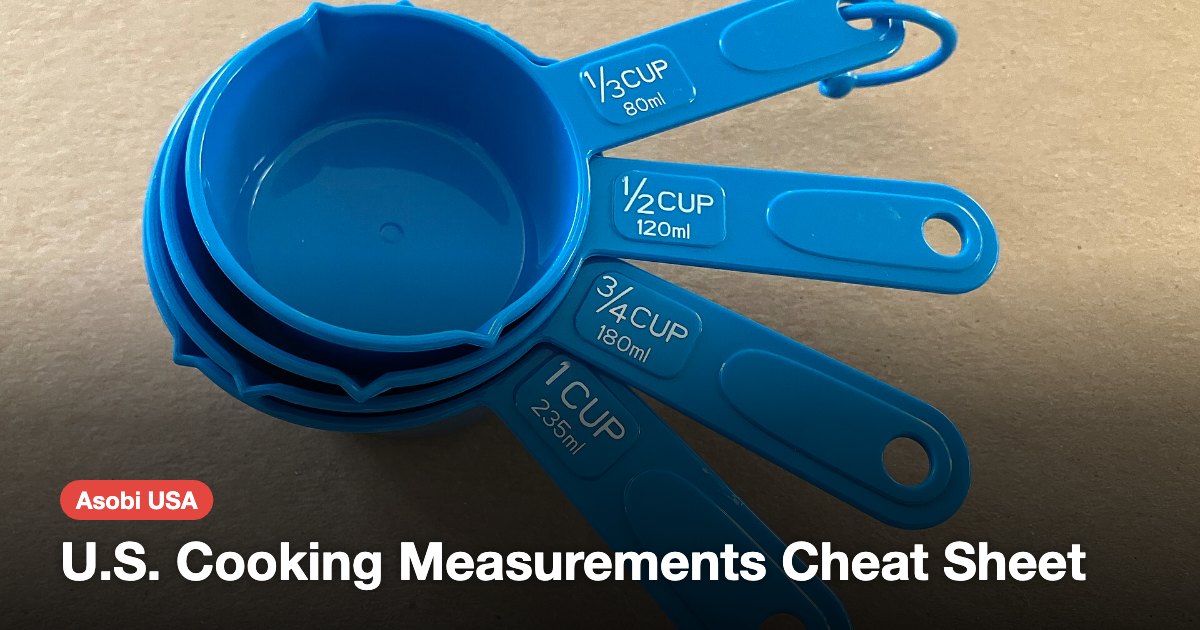
The featured image shows an example of measuring cups. The 1 cup in the photo is marked 235 mL. Product markings are rounded differently, so check the conversion table in this article and the specifications of the recipe you use. Photo: Estabiano / Wikimedia Commons (CC0 1.0, taken in 2024).
This article is also available in Japanese.