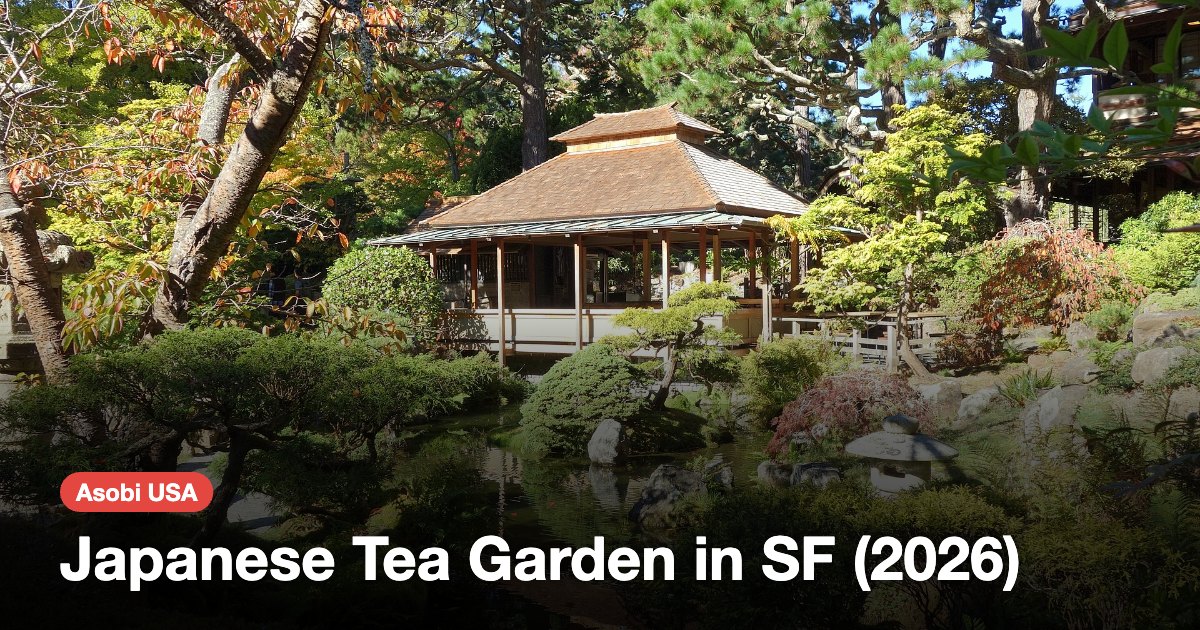
If you want to visit a Japanese garden in San Francisco, the Japanese Tea Garden in Golden Gate Park is a good option. It is in a different place from Japantown, so rather than packing your schedule the way you would for a stroll around town, the key is to check the entry times and how you will get there first.
In this article, we have organized the official admission hours, the free admission hours on Mondays, Wednesdays and Fridays, and how these differ from the hours of the tea house inside the garden. We also share ideas for fitting a visit into a half day with family or friends.
What you will learn in this article
- Where the Japanese Tea Garden is, and the last entry time, which changes by season
- Which days have free admission hours, and where to check when looking up prices
- Things to keep in mind when combining the garden, the tea house and other facilities in the park
Information checked: October 15, 2026. We checked the official information from the operating organization, Gardens of Golden Gate Park (GGGP), and from the operator of the tea house and gift shop. All times are San Francisco local time. Admission conditions and temporary closures may change, so please check the official pages before you visit.
Quick reference: location, admission hours and free hours
| Item | Official information | Planning tips |
|---|---|---|
| Address | 75 Hagiwara Tea Garden Dr., San Francisco, CA 94118 | Inside Golden Gate Park. Not in the same place as Japantown |
| Opening | 9 a.m. daily | Check the official information on the day for temporary changes |
| Last entry, March–October | 5:30 p.m. | Last entry is 30 minutes before closing |
| Last entry, November–February | 4:30 p.m. | In winter, the late-afternoon entry cutoff comes earlier |
| Free admission hours | Mondays, Wednesdays and Fridays, 9–10 a.m. | Applies to admission. Check food and drinks and other costs separately |
“Last entry” means you can enter the garden up to that time. It does not mean you can stay for a long time after arriving in the late afternoon, so if you want to take your time, avoid arriving just before the cutoff.
The Japanese Tea Garden and Japantown are in different places
The Japanese Tea Garden is inside Golden Gate Park, near Hagiwara Tea Garden Drive and Martin Luther King Drive. It is not in the same neighborhood as Japantown, where restaurants and shops are concentrated. When searching on a map, enter “Japanese Tea Garden” together with the address.
If you plan to visit both on the same day, decide whether you will have lunch at the garden or in Japantown before planning your route; this reduces overlap in your schedule. If you treat touring the garden, eating and shopping in town as separate blocks of time, you won’t feel rushed while getting around.
Public transit routes vary depending on where you start. Check the public transit information on GGGP’s directions and hours page, and also look up the latest service information from the transit agency. Rather than setting your destination using only the name of a facility in the park, check the route to the garden entrance.
Free admission is on Monday, Wednesday and Friday mornings
According to GGGP’s official information, free admission hours for the Japanese Tea Garden are Mondays, Wednesdays and Fridays, 9–10 a.m. This does not mean every facility in the park is free on these days and at these times.
If you want to use the free hours, we recommend planning with plenty of time to reach the entrance. The time you arrive at the parking lot or transit stop is different from the time you actually go through admission, so factor in the possibility of getting lost along the way.
Also, free admission and food and drink costs are separate. If you order tea or light snacks at the tea house, check the shop’s menu and prices. The conditions for joining special events or programs also need to be checked separately from regular garden admission.
How to check regular admission prices
To look up regular admission prices and discounts, select your visit date and the facility on GGGP’s official ticket page. If categories such as residents, age groups or members are shown, also check the eligibility requirements and any proof required.
This article does not copy old price lists or amounts from third-party sites as regular 2026 prices. If price is an important factor in your comparison, confirm the date, number of people and ticket type on the final purchase screen before setting your budget.
If you plan to visit several gardens, it is also important not to confuse single-admission tickets with tickets for multiple facilities. If you only plan to visit one, there is no need to add stops to your itinerary just to visit other facilities. Decide first which places you want to see, and compare based on what you will actually use; that makes it easier to choose.
Even within the same park, last entry times and free hours differ by facility. On days when you visit several facilities, check the cutoff for the last place you will visit in advance, and decide the order with travel time in mind.
Check the tea house and gift shop separately from the garden’s last entry
The Japanese Tea Garden’s tea house and gift shop are run by an independent operator, JTGSF. The hours listed on its official website are 9 a.m.–5:45 p.m. from March 1 to October 31, and 9 a.m.–4:45 p.m. from November 1 to February 28. These are not the same as the garden’s last entry times.
On days when having tea is your main goal, also check the official hours for the tea house and gift shop. Close to closing time, check with the shop about ordering and service, and don’t assume that being able to enter the garden means you can still order.
If you want to see the garden and eat in the same visit, rather than planning right up to the last entry time, allow time to see the garden after you arrive and take a break if needed; that way you can explore at a relaxed pace. Check portion sizes and the menu in the official information before your visit or at the shop on the day.
Half-day plan: make the garden the centerpiece and leave some slack
Below is a sample plan from our editors centered on the garden. Since how long you stay depends on your walking pace and the weather, the idea is not to build a minute-by-minute itinerary but to set aside time for breaks and travel separately.
- Before you leave: Check the official last entry time, whether you will use the free hours, and your route there and back.
- On arrival: Note where the stop or parking lot you will use on the way back is, then head into the garden.
- Touring the garden: Even at spots where you want to take photos, don’t block the paths, and match the walking pace of your companions.
- Break: Check the tea house hours and stop there, or move on to your next destination in the park.
- Afternoon plans: If you move on to another garden or into the city, add just one stop and leave time for the trip home.
The right plan differs between a day when you prioritize the free hours and a day when you prioritize a departure time that works for your family. If you decide based not only on cost but also on the effort of getting there and your companions’ stamina, you will have a more comfortable half day.
Tips for visiting with kids, on rainy days and for photography
- Since you will be walking around the garden, choose comfortable, non-slip shoes.
- Bring a jacket that can handle changes in weather and temperature, and check opening and travel conditions in rainy weather on the day.
- If stroller or wheelchair routes, or the facilities available, are important to you, check GGGP’s accessibility information in advance.
- Check the official rules on bringing pets, using camera equipment and so on. Don’t confuse what is allowed with general admission with photography that requires a permit.
- On days with kids, allow time not just for taking photos but also for breaks, restrooms and the trip home.
Three things to decide with your companions
Before you leave, agree on whether seeing the garden or resting at the tea house is the priority, whether you will move to another neighborhood in the afternoon, and how you will change plans if it rains heavily. Even with the same plan to “go to the garden,” someone who wants to take photos and someone who wants a short walk need different amounts of time.
On days when the free morning hours are hard to make, you can also choose regular admission after checking its conditions instead of forcing an earlier start. If there is a limit to how much time you can spend in the park, cutting back on plans to visit multiple facilities lets you secure time to enjoy the garden itself.
Frequently asked questions
Until what time can I enter the Japanese Tea Garden?
According to the official information, last entry is 5:30 p.m. from March to October and 4:30 p.m. from November to February. Last entry is stated to be 30 minutes before closing. Please check for temporary changes before your visit.
When is admission free?
Mondays, Wednesdays and Fridays from 9 to 10 a.m. are listed as free admission hours. This does not make food, drinks or special program fees free.
Can I walk there from Japantown and visit both together?
They are in different neighborhoods. If you visit both on the same day, look up travel between the two as a separate part of your plan, and set aside time for meals and shopping too.
If you are also planning to explore the city on foot, see our San Francisco Japantown guide. When looking for Japanese communities in other cities, also see Japanese supermarkets and Japanese ingredients in LA.
You might also like: California Academy of Sciences guide for families with kids
Summary
At the Japanese Tea Garden, it is important to check not only the opening time but also the seasonal last entry time and the tea house hours separately. Even when using the free hours, allow plenty of time to get to the entrance, and build a relaxed plan with the garden as the centerpiece.
Sources and references (checked October 15, 2026)
- GGGP: Admissions & Hours
- GGGP: Official ticket information
- GGGP: Japanese Tea Garden
- JTGSF: Tea house and gift shop operator information
- JTGSF: Hours and visitor information
This article is also available in Japanese.
Featured photo: Daderot / Wikimedia Commons (CC0 1.0, taken in 2013).